Waxahachie, TX
Water heater maintenance and flushing in Waxahachie
Sediment settles in the bottom of a tank water heater over the years, and a few parts wear out quietly. Maintenance means looking the heater over, flushing the tank when that makes sense, and catching small problems before they turn into a leak or a cold shower. We serve Waxahachie and the towns within about 30 miles. Call us and we will talk through your heater.
The service
What water heater maintenance and flushing involve
Maintenance is a check of the heater and the parts that keep it safe and working. Flushing is one part of it: draining water out of the tank to carry away the sediment that has settled at the bottom. For a tank heater, a visit can include:
- Looking over the heater, its connections and the area around it for leaks, rust or damage.
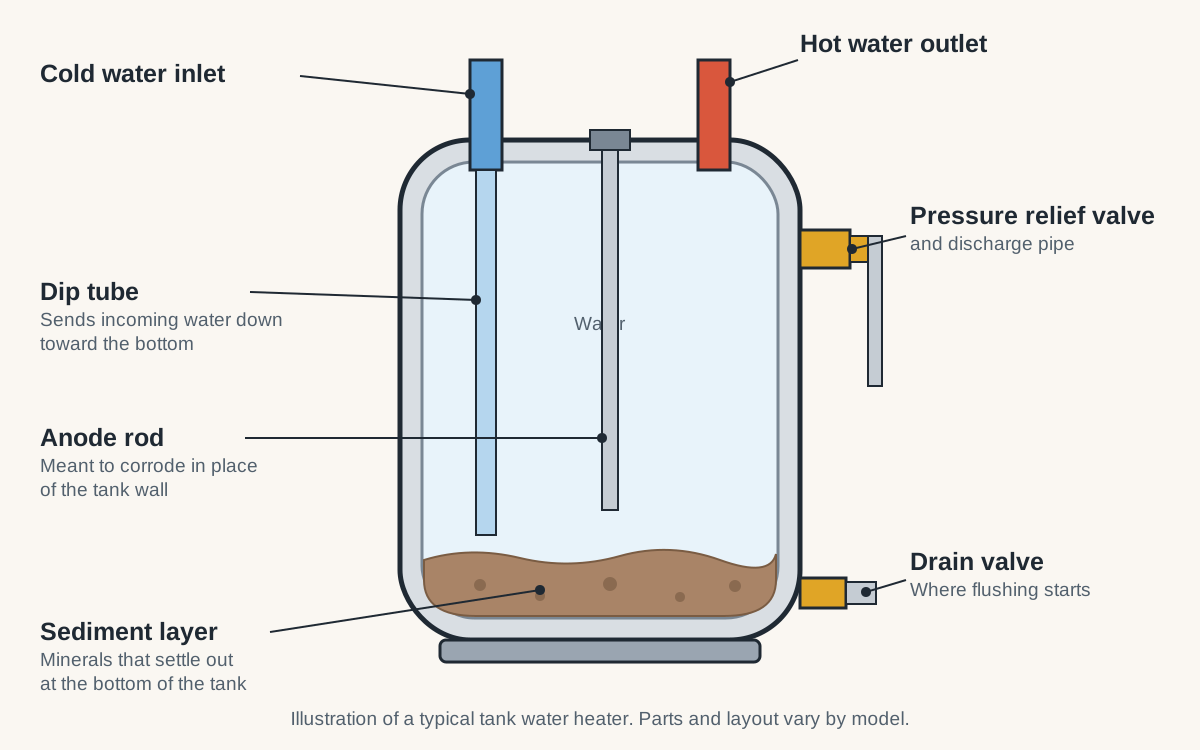
- Checking the temperature and pressure relief valve, the safety valve that lets water out if pressure or heat gets too high.
- Checking the drain valve and flushing the tank to clear sediment, when the heater and its condition allow it.
- Looking at the anode rod, the metal rod inside the tank that is meant to corrode in place of the tank wall, where it can be reached.
- On a gas heater, the venting, burner area and air supply. On an electric heater, the heating elements and thermostats.
What gets done on a given heater depends on its make, its model and its condition. The manufacturer's manual is the starting point.
Why it matters
Why sediment builds up in a tank
Water carries dissolved minerals. When it is heated in a tank, some of those minerals settle out as scale and sediment and collect at the bottom. How much builds up depends on your water supply, how the heater is used and how long it has been since the tank was last flushed. Mineral content varies from one water supply to another, so we do not assume the same amount for every home.
Sediment can make a heater work harder to heat the water. It can also cause popping or rumbling noises and, over time, add to wear on the tank and its parts. Those symptoms have other possible causes too, which is why a look at the heater comes before assuming sediment is the problem.
Timing
How often should a water heater be flushed?
No single interval fits every heater. A. O. Smith, a water heater manufacturer, says most tank water heaters should be flushed at least once a year, that homes with hard water may need it more often, and that the owner's manual for your model is what to follow. Other makes and models can differ, so check yours. If you do not know when the tank was last flushed, or the heater is older, we would rather look at it first than flush it blindly.
What you might notice
Signs your water heater may need a look
- Popping, rumbling or crackling noises when the heater runs
- Hot water that runs out sooner than it used to
- Cloudy, rusty or discolored hot water
- Water that takes longer to heat
- Moisture, rust or a puddle around the base of the tank
None of these proves sediment is the cause. If the water is gone completely, see no hot water in Waxahachie. If water is pooling around the heater, see water heater leaking.
Older tanks
Flushing an older tank: why we like to inspect first
Flushing an old tank that has never been flushed is not always a simple job. Heavy sediment can clog the drain valve so the tank will not drain, and an old drain valve can start to drip once it has been opened. If your heater is well into the age where you would expect to replace it, an inspection can tell you whether flushing makes sense or whether it is time to look at replacement.
We cannot promise what a flush will fix. It does not repair a failed part, and it will not always change noise or hot water supply.
Doing it yourself
Can I flush it myself?
Some homeowners do, and manufacturers publish instructions for it. The job involves hot water, a drain valve at the bottom of the tank, and gas or electric power to the heater, so it is only worth doing if you are comfortable with that and follow the manual for your model. We do not give step by step instructions here because the right steps depend on the heater.
Do not work on gas lines, electrical connections or the relief valve discharge pipe unless you know how. If the drain valve will not open, drips, or the water will not run clear, stop and call us.
Tank or tankless
Tank and tankless heaters are maintained differently
A tankless water heater has no tank, so it is not flushed the way a tank heater is. Many tankless units do need scale cleared with a descaling solution, which is a different job with different equipment. This page is about tank heaters. For tankless units, see tankless water heater descaling and flushing, or tankless water heater repair, or call us and tell us the make and model.
Safety first
Gas, electric and when to stop
- Gas smell: leave the house and call the gas utility before anything else.
- Water near outlets, the panel or the heater's wiring: stay clear, and turn off power only if you can safely reach the breaker. Then call us.
- Active leak: shut off the water to the heater if you can, then call.
- Water or steam from the relief valve or its pipe, or a heater that is banging or bulging: do not keep running it. Call us.
For anything past routine care, leave gas and electrical parts to a qualified technician. See gas water heater repair and electric water heater repair.
Before you call
What to expect when you call
Tell us your street address and town, whether the heater is gas, electric or tankless, how old it is if you know, when it was last flushed, and anything it is doing, such as noise, less hot water or discolored water. We will talk through what makes sense for that heater. Ask us about pricing and anything else you want to know when you call. Our service areas page lists the towns we cover.
Questions
Water heater maintenance and flushing FAQ
How often should a water heater be flushed or serviced?
It depends on the heater. A. O. Smith says most tank water heaters should be flushed at least once a year and that hard water may call for it more often. Follow the manual for your make and model.
Will a plumber flush a water heater, and is it worth it?
Yes, we can. Whether it is worth doing depends on the heater's age and condition. Flushing clears sediment but does not repair a failed part, and an older tank is better inspected first.
Should I flush a 15 or 20 year old water heater?
It depends on the heater. An old tank that has never been flushed can have a clogged or worn drain valve, so we like to look at it first. At that age it may also be a good time to talk about replacement.
What are the signs of sediment buildup?
Popping or rumbling noises, hot water that runs out sooner, and cloudy or rusty water are common signs. Each has other possible causes, so a look at the heater tells you more than the symptom does.
What happens if a water heater is never flushed?
Sediment can pile up in the bottom of the tank, make the heater work harder and add to wear on the tank and parts. We cannot say when any particular heater will fail.
How long does flushing take?
It depends on the tank size, how much sediment is in it and whether the drain valve works well. We do not promise a time on a web page. Ask us when you call.
How much does water heater maintenance cost?
It depends on the heater and its condition, so we do not put numbers on this page. Call us, tell us about the heater and ask.
What is the difference between draining, flushing and descaling?
Draining empties the tank. Flushing drains it while clearing out sediment. Descaling is a cleaning with a solution, mostly used on tankless heaters, which have no tank to flush.
Is tankless water heater maintenance different?
Yes. A tankless heater is not flushed like a tank heater, and many need descaling instead. See tankless water heater descaling and flushing or call us with the make and model.
Have a water heater that needs a look?
Call us and tell us what your heater is doing. Water Heater Repair in Waxahachie, 400 Dunn St, Waxahachie, TX 75165.
Tap to call(972) 472-8849